

- luxurysedandc
How Does a Chauffeured Car Service Differ From Traditional Car Rental Options?
Quick Answer: A chauffeured car service provides a professionally licensed driver who manages navigation, timing, safety, and passenger comfort, while a traditional car rental gives customers temporary access to a vehicle they must drive themselves. The difference goes beyond who holds the steering wheel. It affects liability, insurance coverage, time efficiency, service level, and overall travel experience. Chauffeur services prioritize convenience and professionalism, whereas rental options prioritize independence and cost control. |
Choosing between a chauffeured car service and a traditional car rental often feels straightforward until real travel pressures set in. Business travelers may struggle with traffic and parking while preparing for meetings. Event hosts worry about timing and coordination. Airport travelers face rental counters, fuel policies, and hidden fees. At the same time, some prefer the independence of driving themselves.
The difference is not simply about who sits behind the wheel. It involves responsibility, insurance, pricing structure, convenience, and overall experience. Understanding these distinctions helps determine when professional services add value and when self-driven flexibility makes more sense.
What Is a Chauffeured Car Service and How Does It Operate?
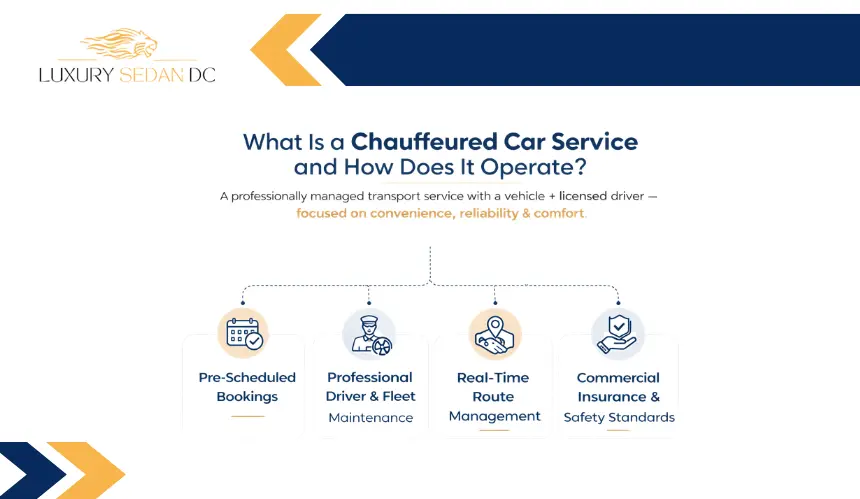
A chauffeured car service is a professionally managed transportation solution in which a vehicle and a licensed driver are provided together under a commercial service structure. Unlike self-drive models, the passenger is not responsible for navigation, traffic decisions, parking, or operational risk. The service is designed around convenience, reliability, and professional presentation rather than simple vehicle access.
At its core, a chauffeur service operates as a regulated commercial transportation provider. The company owns or manages a fleet, employs trained drivers, maintains commercial insurance, and complies with industry licensing requirements. This structure shifts responsibility from the passenger to the service provider.
Operational Structure and Service Model
Most chauffeured services function through:
- Pre-scheduled reservations via online booking systems or corporate accounts
- Hourly or flat-rate pricing models
- Door-to-door pickup and drop-off
- Real-time route management and traffic monitoring
- Professional driver screening and background checks
- Commercial vehicle maintenance and inspection standards
Because the driver is an employee or contracted professional, the company assumes operational liability, fuel management, and route planning. This removes common travel stress points, such as unfamiliar roads, parking searches, tolls, and last-minute navigation errors.
Experience and Service Standards
Chauffeur services prioritize presentation and passenger comfort. Vehicles are typically maintained to higher aesthetic and cleanliness standards, especially in executive and luxury segments. Drivers are trained in professional etiquette, punctuality, and discretion, which becomes particularly important for:
- Corporate transportation
- Airport transfers with tight schedules
- VIP guest hosting
- Wedding and event logistics
- City-to-city executive travel
The emphasis is not merely on transportation but on managed mobility. Passengers can focus on productivity, preparation, or relaxation while the driver handles logistics. For business travelers, this often translates into measurable time efficiency and reduced cognitive load during high-pressure schedules.
Understanding this operational and structural model clarifies why chauffeur services are priced differently and why they are often positioned as premium or executive transportation solutions rather than simple vehicle rentals.
What Defines a Traditional Car Rental Service?
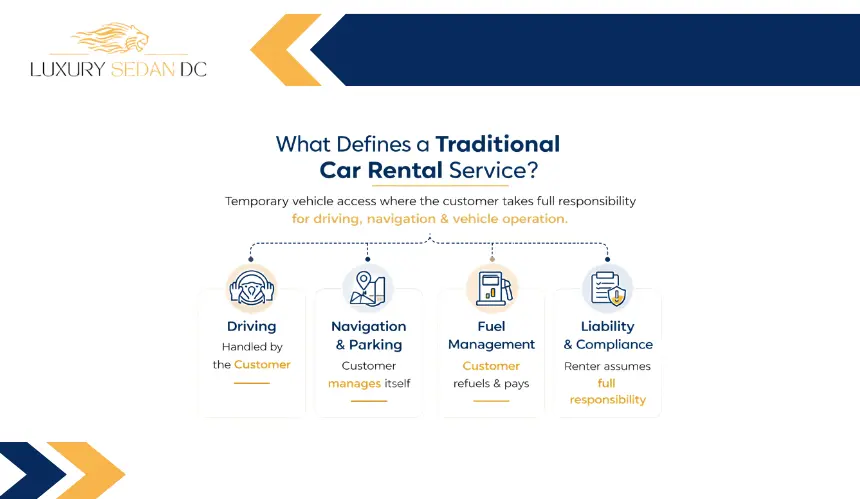
A traditional car rental service provides temporary access to a vehicle that the customer drives independently. The company supplies the car under a rental agreement, but operational responsibility shifts to the renter. This model is built around flexibility, personal control, and short-term vehicle access rather than managed transportation.
Unlike a chauffeur-based model, a rental company’s role typically ends once the vehicle is handed over. The customer assumes responsibility for driving, navigation, parking, fuel management, and compliance with traffic laws during the rental period.
How the Rental Model Is Structured
Traditional car rental services generally operate through:
- Daily or weekly rental agreements
- Mileage-based or unlimited mileage plans
- Security deposits or credit card holds
- Optional insurance upgrades
- Fuel return policies
- Vehicle pickup and return at designated locations
Pricing often appears lower at first glance because it covers only vehicle use. However, total cost can fluctuate depending on add-ons such as insurance coverage, additional drivers, GPS systems, child seats, fuel charges, and late return fees.
Responsibility and Risk Allocation
One of the defining differences in this model is liability. The renter assumes responsibility for:
- Vehicle damage during the rental period
- Traffic violations and parking penalties
- Fuel refills
- Route planning and navigation
- Safe vehicle operation
While rental companies provide base insurance coverage, customers often purchase supplemental protection to reduce personal financial exposure. This structure prioritizes independence but also transfers operational risk to the driver.
When Rental Services Make Practical Sense
Traditional rentals are often ideal for:
- Extended vacations or road trips
- Multi-day travel requiring constant vehicle access
- Budget-conscious travelers prioritizing cost control
- Remote destinations where driver services may be limited
The rental model is centered on autonomy. For travelers who prefer full control over their schedule and are comfortable managing traffic and logistics, this option offers flexibility. However, that flexibility comes with direct responsibility for time management, driving stress, and potential liability.
Key Structural Differences Between Chauffeured Service and Traditional Car Rental
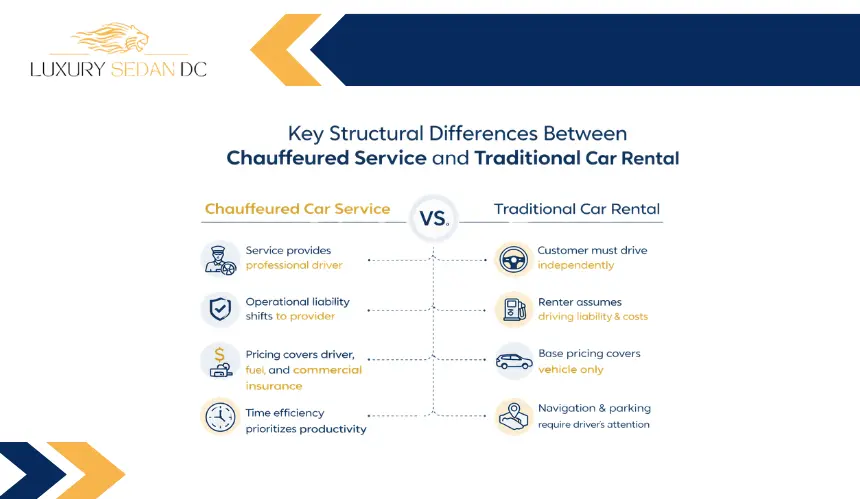
At a surface level, the difference seems simple: one includes a driver and the other does not. Structurally, however, these models operate under entirely different responsibility, pricing, and service frameworks. Understanding these distinctions helps determine which option aligns with specific travel goals rather than defaulting to price alone.
Driver Responsibility and Operational Control
In a chauffeured model, the transportation company manages:
- Professional driver employment and training
- Route planning and traffic adaptation
- Vehicle presentation and readiness
- Punctual arrival coordination
With traditional rentals, the customer assumes full control. That includes navigation, parking decisions, toll management, and real-time problem solving in unfamiliar areas.
Did You Know?
According to transportation safety data from the National Highway Traffic Safety Administration, unfamiliar road environments significantly increase driver stress and reaction time variability. Professional drivers who operate daily in specific service areas are trained to mitigate these risks through route familiarity and defensive driving techniques.
Insurance Coverage and Liability Allocation
This is one of the most overlooked differences.
Chauffeured transportation typically operates under commercial auto insurance policies that cover the driver, vehicle, and passengers in accordance with regulatory standards. The service provider assumes operational liability.
In contrast, rental car agreements often place primary responsibility on the renter. Even with insurance add-ons, deductibles, exclusions, and coverage limits can apply.
Pro Tip: Before renting, review whether your personal auto policy or credit card provides rental coverage. Many travelers overpay for duplicate insurance due to uncertainty.
Time Efficiency and Productivity Value
Time has measurable value, particularly for business travelers.
With a chauffeur service:
- Travel time can be used for calls, email review, or meeting preparation
- Parking searches are eliminated
- Drop-off and pickup occur at exact locations
With a rental vehicle:
- Time is spent navigating unfamiliar streets
- Parking fees may apply
- Vehicle return procedures add administrative time
Did You Know? Corporate mobility studies show that business travelers lose an average of 30–45 minutes per urban trip to parking and navigation adjustments. Over multiple meetings, this compounds into measurable productivity loss.
Cost Perception Versus Total Cost
Rental cars often appear cheaper upfront. However, the total cost may include:
- Fuel
- Insurance add-ons
- Parking fees
- Tolls
- Security deposit holds
- Time spent retrieving and returning the vehicle
Chauffeur services typically present transparent hourly or flat-rate pricing, especially for airport transfers and event bookings.
Smart Comparison Trick: For short-duration trips in high-traffic cities, calculate the full cost of parking, fuel, and time spent navigating before assuming a rental is more economical.
Experience and Service Standard
Chauffeur services emphasize:
- Professional etiquette
- Clean, presentation-ready vehicles
- Scheduled precision
- Passenger-focused comfort
Rental services prioritize:
- Vehicle availability
- Category selection
- Independent use
The difference is not purely financial. It reflects two transportation philosophies: managed mobility versus self-managed driving.
Pricing Model Comparison: Chauffeured Service vs Traditional Car Rental
Below is a structured comparison to make the cost differences easier to evaluate at a glance:
Comparison Factor | Chauffeured Car Service | Traditional Car Rental |
Base Pricing Model | Hourly rate or flat-rate (airport/event-based) | Daily or weekly base rate |
What the Price Includes | Vehicle, professional driver, fuel, commercial insurance | Vehicle only (driver not included) |
Insurance Structure | Commercial policy typically included | Basic coverage included; upgrades are often extra |
Fuel Costs | Usually included in the rate | Renter is responsible for refueling |
Security Deposit | Often not required for standard bookings | A credit card hold or security deposit is common |
Parking Costs | Not applicable to passengers | Renter pays for parking |
Add-On Charges | Waiting time beyond the limit, special requests | Additional drivers, GPS, insurance upgrades, and young driver fee |
Cost Predictability | High for short trips and airport transfers | Variable depending on mileage, fuel, and add-ons |
Best Value Scenario | Short-duration trips, business meetings, airport transfers | Multi-day travel, road trips, and extended use |
Smart Evaluation Tip
Instead of comparing daily rates alone, calculate:
- Total travel hours
- Parking expenses
- Fuel costs
- Insurance upgrades
- Time spent picking up and returning the vehicle
In shorter, time-sensitive trips, bundled chauffeur pricing can be more predictable. In extended travel situations requiring continuous independent mobility, rental structures typically provide stronger cost efficiency.
How Do Safety, Licensing, and Professional Standards Compare?
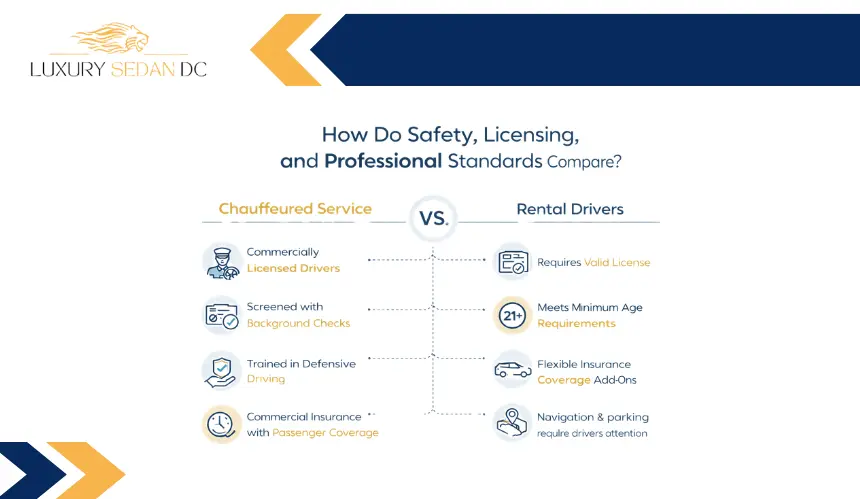
Beyond pricing and convenience, safety and regulatory standards represent a major structural difference between a chauffeured car service and a traditional car rental. While both operate legally within transportation frameworks, the level of oversight and responsibility allocation differs significantly.
Driver Qualification and Screening
In a chauffeured service model, drivers are typically:
- Professionally licensed under commercial regulations
- Subject to background checks
- Trained in defensive driving
- Experienced in high-traffic and executive environments
- Evaluated for professional conduct and etiquette
The company assumes responsibility for ensuring that drivers meet safety and compliance standards.
In contrast, rental companies do not provide a driver. The renter’s qualification is generally limited to:
- Valid driver’s license verification
- Minimum age requirement
- Payment authorization
Once the vehicle is released, the rental company no longer controls how it is operated.
Did You Know?
Commercial transportation providers often carry significantly higher liability insurance limits than personal auto policies, especially in corporate or executive service tiers.
Insurance and Risk Allocation
Chauffeured services typically operate under commercial auto insurance policies that are designed for passenger transportation. These policies are structured to protect:
- The driver
- The passenger
- The vehicle
- Third parties in the event of an accident
Because the driver is employed or contracted by the service, operational liability is centralized within the company.
Rental services operate differently. Even when base insurance is included, renters may still be responsible for:
- Deductibles
- Damage not covered by waiver policies
- Traffic violations
- Personal injury gaps depend on coverage selection
Pro Tip:
Many renters assume “full coverage” eliminates all risk. In reality, collision damage waivers are not always comprehensive insurance policies and may include exclusions.
Vehicle Maintenance and Inspection Standards
Chauffeured fleet vehicles are often maintained under stricter inspection cycles due to commercial use requirements. This may include:
- Routine mechanical checks
- Scheduled preventive maintenance
- Cleanliness standards aligned with executive service expectations
Rental fleets are also professionally maintained, but vehicles cycle through multiple drivers with varying driving habits, which can influence wear-and-tear patterns.
Stress and Cognitive Load Considerations
Safety is not only about accident rates. It also involves mental workload.
Driving in unfamiliar cities increases cognitive strain due to:
- Navigation uncertainty
- Traffic pattern unpredictability
- Parking pressure
- Time sensitivity
With a chauffeur service, that cognitive load shifts to a trained driver. The passenger can focus on preparation, communication, or relaxation instead of decision-making under traffic pressure.
When Should You Choose a Chauffeured Service Instead of a Rental?
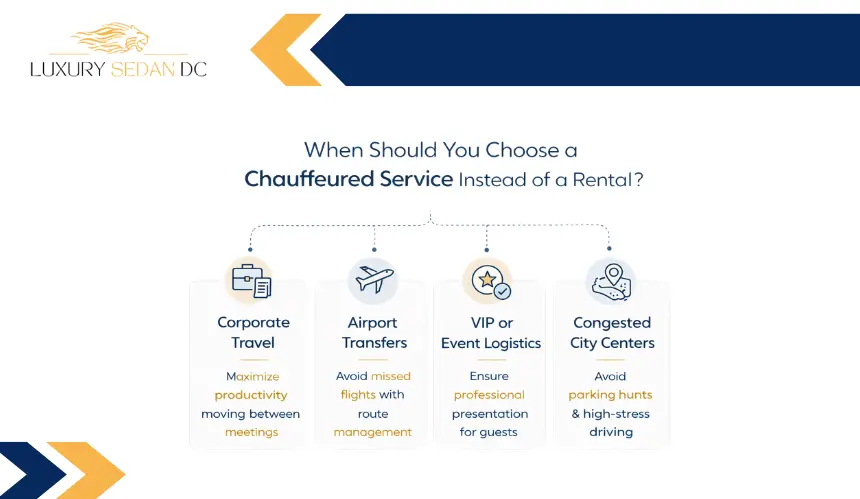
The decision often depends less on price and more on context. A chauffeured car service becomes strategically valuable when time sensitivity, presentation, coordination, or reduced liability outweigh the need for independent control.
Situations Where Chauffeur Service Makes Practical Sense
- Business Meetings and Corporate Travel
When traveling between meetings in unfamiliar or congested areas, productivity becomes critical. A chauffeur allows executives to prepare, take calls, and manage schedules without distraction. Time lost to parking or navigation can affect performance. - Airport Transfers With Tight Schedules
Professional drivers monitor traffic conditions and adjust routes in real time. This reduces the risk of missed flights or delays caused by parking searches and rental return procedures.
Did You Know? Airport parking in major metropolitan areas can exceed daily rental base rates during peak travel seasons, particularly for short trips.
- VIP Guest Hosting or Client Transportation
First impressions matter. Professional presentation, punctuality, and driver etiquette can reflect directly on a company’s brand. - Weddings and Event Logistics
Coordinating multiple arrivals and departures requires precision. A managed transportation service reduces coordination stress and ensures timing consistency. - High-Traffic Urban Travel
In dense city centers where parking is limited and traffic is unpredictable, the convenience of direct drop-off and pickup often outweighs the benefits of self-driving.
When Is a Traditional Car Rental the Better Option?
A rental car provides autonomy and flexibility that make sense in specific scenarios.
- Extended Vacations or Road Trips
If travel involves daily independent driving across multiple destinations, rentals provide continuous mobility at a controlled cost. - Remote or Rural Destinations
In areas where chauffeur services may be limited or unavailable, renting ensures transportation access. - Budget-First Travel Planning
For travelers who prioritize cost over convenience, especially for multi-day use, rentals often result in lower cumulative expenses. - Multi-Driver Flexibility
Families or groups who wish to rotate drivers benefit from the shared-access rental model.
Decision-Making Tip
Instead of asking which option is cheaper, consider:
- How many total driving hours are required?
- Is parking readily available?
- Is time productivity important during travel?
- What level of liability are you comfortable managing?
- Does presentation matter in this trip context?
Transportation decisions are situational. Chauffeured services prioritize managed convenience and reduced stress, while traditional rentals prioritize independence and cost efficiency over longer durations.
Frequently Asked Questions
What is the main difference between a chauffeured car service and a traditional car rental?
A chauffeured car service includes a professionally licensed driver who manages navigation, timing, and vehicle operation under commercial insurance coverage. A traditional car rental provides access to a vehicle that the customer drives independently, assuming responsibility for operation, parking, and most liability during the rental period.
Is a chauffeured car service always more expensive than renting a car?
Not necessarily. While hourly chauffeur rates may appear higher upfront, short trips in high-traffic areas can narrow the cost gap when parking fees, fuel, insurance add-ons, and time spent retrieving and returning rental vehicles are factored in.
Does a chauffeur service include insurance coverage?
Yes. Chauffeured transportation typically operates under commercial auto insurance policies that cover the driver, passengers, and vehicle during service. Rental cars include base coverage, but renters may still be responsible for deductibles, exclusions, or additional protection upgrades depending on their agreement.
When is renting a car more practical than hiring a chauffeur?
Car rentals are generally more practical for multi-day trips requiring constant independent driving, such as road trips or extended vacations. The daily rate structure makes rentals cost-effective when continuous vehicle access is needed rather than short-duration, time-sensitive transportation.
Can chauffeur services be booked for hourly use?
Many chauffeur services charge an hourly minimum, particularly for business travel, event transportation, or city transfers. This structure provides flexibility for multiple stops and waiting time without requiring the passenger to manage parking or vehicle logistics.
Are chauffeur services only for luxury vehicles?
While many services offer executive and luxury fleets, chauffeured transportation is not limited to high-end vehicles. Providers may offer standard sedans, SUVs, or specialty vehicles depending on client needs, group size, and service type.