

- luxurysedandc
Airport Transfers vs Rideshare: Understanding Key Differences
Travelers often treat airport transportation as a simple, last-minute decision, assuming all options deliver similar convenience and reliability. In reality, airport transfers and rideshare services operate under very different models that affect timing, accountability, comfort, and stress levels. Individuals researching airport transfer services in Centerville, Virginia, typically compare options to determine which best supports smooth departures and predictable arrivals.
Understanding these differences helps travelers choose transportation based on their risk tolerance, scheduling needs, and overall travel experience, rather than relying on assumptions or price alone.
How Airport Transfers and Rideshare Services Are Structurally Different
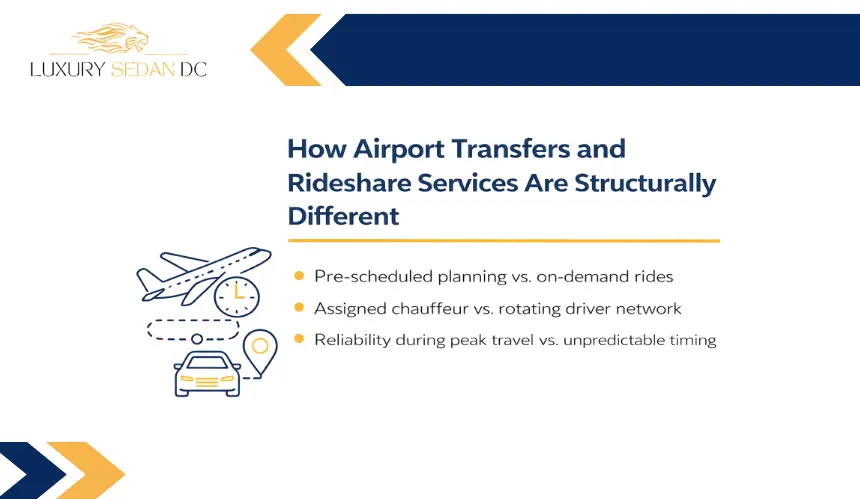
The most fundamental differences between airport transfers and rideshare services lie in how each is organized and delivered. These structural distinctions influence everything from reliability and communication to how well each option performs during peak travel periods or unexpected disruptions. Understanding the service structure clarifies why outcomes can vary widely between the two transportation options.
Pre-Scheduled Planning vs On-Demand Availability
Airport transfer services are built on advanced scheduling, enabling trips to be planned based on flight times, traffic patterns, and buffer windows. This structure emphasizes preparation and predictability. Rideshare services rely on real-time driver availability, which can fluctuate due to demand, weather, or driver cancellations. While flexible, on-demand availability introduces uncertainty when timing is critical.
Assigned Chauffeur vs Rotating Driver Network
With airport transfers, a specific chauffeur or vehicle is typically assigned in advance, creating clear accountability for the trip. Rideshare platforms operate through a rotating pool of drivers whose availability can change rapidly. This difference affects consistency, communication clarity, and traveler confidence, especially for early-morning flights or late-night airport pickups.
Reliability and Timing as Core Decision Factors

Reliability is often the deciding factor for travelers choosing between airport transfers and rideshare services. Missed pickups, delays, or unpredictable arrival times can disrupt entire travel plans, making timing accuracy essential rather than optional. Evaluating how each option manages reliability helps travelers align transportation choices with their schedule sensitivity.
Predictability for Time-Sensitive Travel
Airport transfers are designed to prioritize punctuality by factoring in traffic conditions, airport congestion, and check-in requirements. This planning reduces variability and supports consistent arrival timing. Rideshare pickup times may vary due to driver availability, surge demand, or last-minute cancellations, increasing the risk of delays during high-traffic travel windows.
Managing Delays and Schedule Adjustments
Professional airport transfer services often track flight status and adjust pickup times automatically when delays or early arrivals occur. Rideshare services typically require passengers to monitor flights and manually update requests. This difference becomes significant during disrupted travel, where proactive adjustment reduces confusion and waiting time after landing.
Pickup Coordination and Airport Logistics

Airports present complex logistical environments that can be overwhelming after long flights or during busy travel periods. How transportation services manage pickups directly affects stress levels, walking distance, and overall arrival experience. Comparing coordination methods highlights practical differences between airport transfers and rideshare services.
Designated Pickup Procedures and Navigation
Airport transfers usually follow predefined pickup protocols, often meeting passengers at specific terminals or curbside locations. Clear instructions minimize confusion and unnecessary walking. Rideshare pickups are commonly restricted to designated zones that vary by airport, requiring passengers to navigate signage, crowds, and unfamiliar layouts immediately after arrival.
Luggage Handling and Arrival Assistance
Chauffeur-based airport transfers often include coordinated luggage handling and curbside assistance, reducing physical strain. Rideshare services typically focus solely on transportation, leaving luggage management entirely to the passenger. For travelers with heavy bags, families, or mobility limitations, this difference significantly affects comfort and ease of arrival.
Vehicle Standards and Passenger Comfort

Comfort and consistency play a larger role in airport transportation than many travelers initially expect, particularly after long flights or during business travel. Vehicle condition, interior environment, and privacy all influence how restorative or stressful the journey feels. Comparing vehicle standards reveals another key distinction between the two service types.
Consistency in Vehicle Quality
Airport transfer fleets are typically maintained to uniform standards regarding cleanliness, space, and presentation. This consistency allows travelers to know what to expect. Rideshare vehicle quality varies widely based on driver participation, vehicle age, and maintenance practices, leading to unpredictable comfort levels.
Privacy, Space, and Ride Environment
Airport transfers often provide quiet, private environments suitable for rest or work. This is especially valuable for business travelers or those recovering from long journeys. Rideshare experiences vary significantly and may include distractions, limited space, or reduced privacy, depending on the driver and vehicle.
Accountability and Service Responsibility

Accountability determines how transportation providers respond when issues arise. Understanding who is responsible for service quality, communication, and problem resolution helps travelers evaluate risk more realistically when choosing between airport transfers and rideshare services.
Managed Service Oversight vs Platform Mediation
Airport transfer providers operate as managed transportation services with defined standards and oversight. Rideshare platforms function primarily as intermediaries connecting drivers and passengers, which can limit direct accountability. This distinction affects consistency and the effectiveness with which concerns are addressed when problems arise.
Communication and Trip Coordination
Pre-arranged airport transfers usually include direct communication before and during the trip, supporting smoother coordination. Rideshare communication relies on app-based messaging and driver responsiveness. Clear communication is especially important during airport pickups, where timing and location precision matter.
Cost Structure and Value Considerations
Cost comparisons between airport transfers and rideshare services require more than a comparison of base pricing. Understanding how pricing is calculated and what is included helps travelers evaluate value rather than focusing solely on upfront cost differences.
Fixed Pricing vs Variable Rate Models
Airport transfer pricing is generally established in advance, providing transparency and predictability. Rideshare pricing fluctuates based on demand, time, and availability, often resulting in surge pricing during peak travel hours or adverse weather conditions. This variability can make budgeting less reliable.
Evaluating Cost Against Reliability and Stress
Lower initial cost does not always translate to better value. Delays, missed pickups, or uncertainty can create stress and downstream expenses. Airport transfers often emphasize reliability and planning, which many travelers consider more valuable than marginal cost savings.
Matching Transportation Choice to Travel Scenarios
The most appropriate transportation option depends on the specific travel context rather than a universal preference. Evaluating how each service performs under different scenarios helps travelers make choices aligned with their priorities and constraints.
Business Travel and Tight Schedules
For business travelers and those with early departures, airport transfers provide scheduled times and reduced uncertainty. Rideshare services may be adequate for flexible schedules, but introduce risk when precise arrival timing is required.
Family, Group, and Luggage-Heavy Travel
Families and groups benefit from coordinated pickups, appropriate vehicle sizing, and reduced logistical complexity. Airport transfers simplify these needs, while rideshare coordination may require additional planning or multiple vehicles.
Frequently Asked Questions
Are airport transfers more reliable than rideshare services?
Airport transfers are generally more predictable due to advance scheduling and structured planning.
Do rideshare services adjust automatically for flight delays?
No. Passengers usually need to manage timing changes manually.
Are rideshares always cheaper than airport transfers?
Not always. Surge pricing can significantly increase rideshare costs.
Which option is better for early-morning flights?
Airport transfers offer greater reliability for early departures.
Do airport transfers include luggage assistance?
Many pre-arranged services offer coordinated luggage handling.
Choosing Transportation Based on Reliability, Planning, and Comfort
Understanding the differences between airport transfers and rideshare services allows travelers to choose transportation based on reliability, accountability, and travel priorities rather than assumptions. Airport transfers emphasize preparation, consistency, and professional coordination, while rideshare services prioritize flexibility and immediate availability. Selecting the right option depends on timing sensitivity, comfort expectations, and tolerance for uncertainty. Travelers seeking structured and dependable transportation often explore providers such as Luxury Sedan DC when predictability and coordination are essential.